Cours théorique & métiers - Shape design Classe A
Dernière mise à jour : 07/08/2026
Description
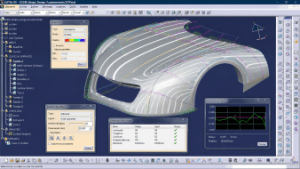
-
Day 1 - Class-A Surfacing Fundamentals
- Morning - Understanding Class-A Requirements and Industry Practices
-
Introduction to Industrial Surface Modelling
- Position of surface modelling within the product development lifecycle
- Differences between:
- Solid modelling
- Functional surface modelling
- Styling surface modelling
- Class-A surfacing
- Why Class-A surfaces are used
- Typical application sectors:
- Automotive
- Aerospace
- Transportation
- Marine
- High-end industrial products
- What Is a Class-A Surface?
- Architecture of a Surface Model
-
Typical Class-A Workflow
- Introduction to a standard industry workflow:
- Styling Intent
- Reference Data
- Master Curves
- Primary Surfaces
- Blends & Transitions
- Analysis
- Correction
- Validation
- Engineering / Manufacturing Release
- Introduction to a standard industry workflow:
- Role of the Class-A Surface Designer
-
Case Study
- Analysis of an industrial component to identify:
- Primary surfaces
- Transition areas
- Character lines
- Styling constraints
- Critical Class-A areas
- Analysis of an industrial component to identify:
- Afternoon - Curve and Surface Theory
- Essential Mathematical Principles
- Influence of Control Points
- Curve Quality
- Continuity Levels
- Industry Exercise
-
Day 2 - Class-A Construction Strategy and Surface Quality
- Morning - Defining a Class-A Modelling Strategy
- Analyse Before Modelling
- Defining Master Curves
- Patch Strategy
- Construction Best Practices
- Blend and Transition Management
- Specific and Complex Areas
- Industry Workshop
- Afternoon - Surface Analysis, Validation and Industrialisation
- Assessing Class-A Surface Quality
- Zebra Analysis
- Reflection and Highlight Analysis
- Surface Defect Diagnosis
- Surface Correction Methodology
- Design – Class-A – Engineering Relationship
-
Product Development Chain
- Design / Styling
- Class-A Surfacing
- Creation of high-quality mathematical surface geometry
- Engineering
- Integration of technical requirements
- Manufacturing / Industrialisation
- Industry Requirements
- Professional Management of an ICEM Surface Model
- Data Organisation
- Model Robustness
- Final Industry Case Study
Objectifs de la formation
By the end of the training, participants will be able to:
- Understand what truly defines a Class-A surface.
- Understand the role of advanced surface modelling within the industrial product development process.
- Differentiate between styling surfaces, functional surfaces and production-ready surfaces.
- Understand the mathematical principles required to create high-quality curves and surfaces.
- Understand and interpret G0, G1, G2 and G3 continuity.
- Define an appropriate construction and patch-layout strategy for a surface model.
- Identify the criteria used to assess the quality of a curve or surface.
- Analyse geometrical and visual surface defects.
- Understand interactions between Design, Engineering and Manufacturing.
- Apply an industry-oriented methodology to validate a Class-A model before release.
Public visé
Prérequis
Modalités pédagogiques
- Formation accessible en présentiel et en distanciel.
- Exercices alternants théorie et pratique.
- Travaux pratiques et projets.
Moyens et supports pédagogiques
- Ingénieurs formateurs expérimentés.
- Supports de cours et exercices.
- Un ordinateur peut être fourni.
- Vidéo projecteur et tableau digital à disposition.
- Connexion internet.
- Des machines virtuelles sont mises à disposition pour les formations à distance.
Modalités d'évaluation et de suivi
- Test de positionnement en amont de la formation.
- Évaluation en cours de formation.
- Évaluation finale.
- Attestation de suivi délivrée à la fin de la formation.
Compétences acquises à l'issue de la formation
- Utiliser l'ISD établi pour créer des courbes de bonne qualité et les surfaces classe A.
- Analyser le filaire et la qualité de la surface et interpréter les résultats afin de corriger les défauts visuels.
Profil du / des Formateur(s)
Informations sur l'admission
Informations sur l'accessibilité
ETC Academy s'engage à ce que ses formations soient adaptables à l'ensemble des participants et à sensibiliser ses formateurs à l'inclusion de tous les publics.
Notre référente handicap est à votre écoute pour étudier vos besoins spécifiques et mettre en place les adaptations nécessaires à votre parcours de formation. N'hésitez pas à nous faire part de vos besoins lors de votre inscription, nous étudierons ensemble les solutions les plus adaptées.
VOTRE INTERLOCUTEUR :
- Caroline SANCHEZ, Référente Handicap
- Téléphone : 06 08 21 77 10
- Email : caroline.sanchez@etc-academy.net
Délais d'accès
Contactez-nous pour discuter de votre projet !
06 08 21 77 10 contact@etc-academy.fr
M'inscrire à la formation
-
Catégorie :
DASSAULT SYSTÈMES
Sous-Catégorie : CATIA V5 - Durée : 14h
-
Prix : 840 € Net de taxePrix INTRA : Nous consulter
- Satisfaction :
- Taux de réussite : - %
- Télécharger le programme
Prochaines Sessions
-
Contactez-nous pour discuter de votre projet !
06 08 21 77 10
contact@etc-academy.fr
Dans la même catégorie
Nos formations certifiantes : une véritable reconnaissance professionnelle !


Chez ETC Academy, nous engageons à vous accompagner tout au long de votre parcours, de la formation à l'obtention de votre certification.
Investissez dans votre avenir professionnel avec nos formations certifiantes et donnez un nouvel élan à votre carrière !